How Elokan
is built
The methodology behind an Elokan formula has four stages: research selection, supplier assessment, production, and independent verification. Each stage is documented and the records are retained by batch code.
From research to released batch
Research-based ingredient selection
Ingredient selection begins with a review of current nutritional literature, specifically research that addresses the dietary intake patterns of physically active men in tropical climates. The review draws from published studies in peer-reviewed nutritional journals, with a focus on minerals, vitamins, and plant-based compounds that appear consistently across multiple independent research papers.
Only ingredients with documented roles in nutritional function — as recognised by bodies such as the European Food Safety Authority (EFSA) — are considered for inclusion. Ingredients with equivocal evidence, or whose active constituent concentrations are not reliably standardisable, are excluded at this stage regardless of their popularity in the wider supplement market.
The selection rationale for each ingredient is recorded as a brief evidence summary and filed alongside the formula specification document. The reference list is updated at the annual formula review.

Supplier assessment and qualification
Every candidate supplier is assessed against a written qualification checklist before a sourcing relationship is established. The checklist covers: documentation of facility standards, chain-of-custody traceability for raw materials, capacity to supply a certificate of analysis with each delivery, and consistency of active constituent concentration across deliveries.
Active ingredients are sourced from documented suppliers, with each batch accompanied by a certificate of composition. Sourcing prioritises suppliers whose facilities maintain food-grade processing standards.
Of the eleven candidate suppliers evaluated during the initial 2023 assessment, four met all qualification criteria and were retained. The retained supplier list is reviewed on a twelve-month cycle. A supplier who cannot provide chain-of-custody documentation for any delivery is placed on review, and that ingredient batch is held until documentation is received.

Production under food-grade standards
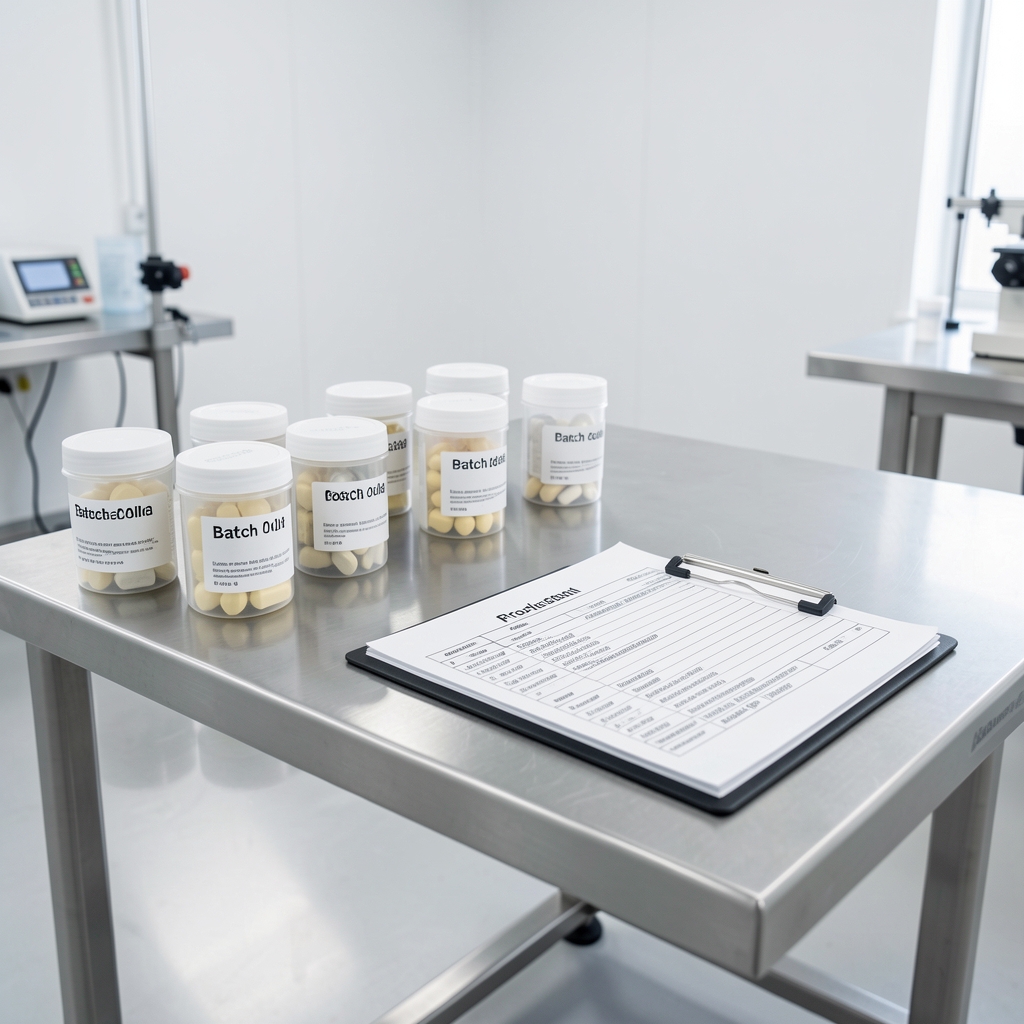
Elokan formulas are produced in a facility that operates to food-grade handling standards. The production line is cleaned and documented between batches. Each production run is assigned a unique batch code, which is printed on the product label and used as the reference key for all associated documentation throughout the supply chain.
Encapsulation uses plant-based soft-gel shells (hydroxypropyl methylcellulose — HPMC). No animal-derived gelatin is used. Filler materials are limited to rice flour and magnesium stearate (plant-derived). No artificial colourants, flavours, or preservatives are introduced at any stage of the production process.
Batch weights, encapsulation yield, and visual appearance are recorded at the time of production. Any batch that falls outside the accepted yield range is flagged and held pending review. The production record for each batch is retained alongside the corresponding independent verification certificate.
Independent batch verification
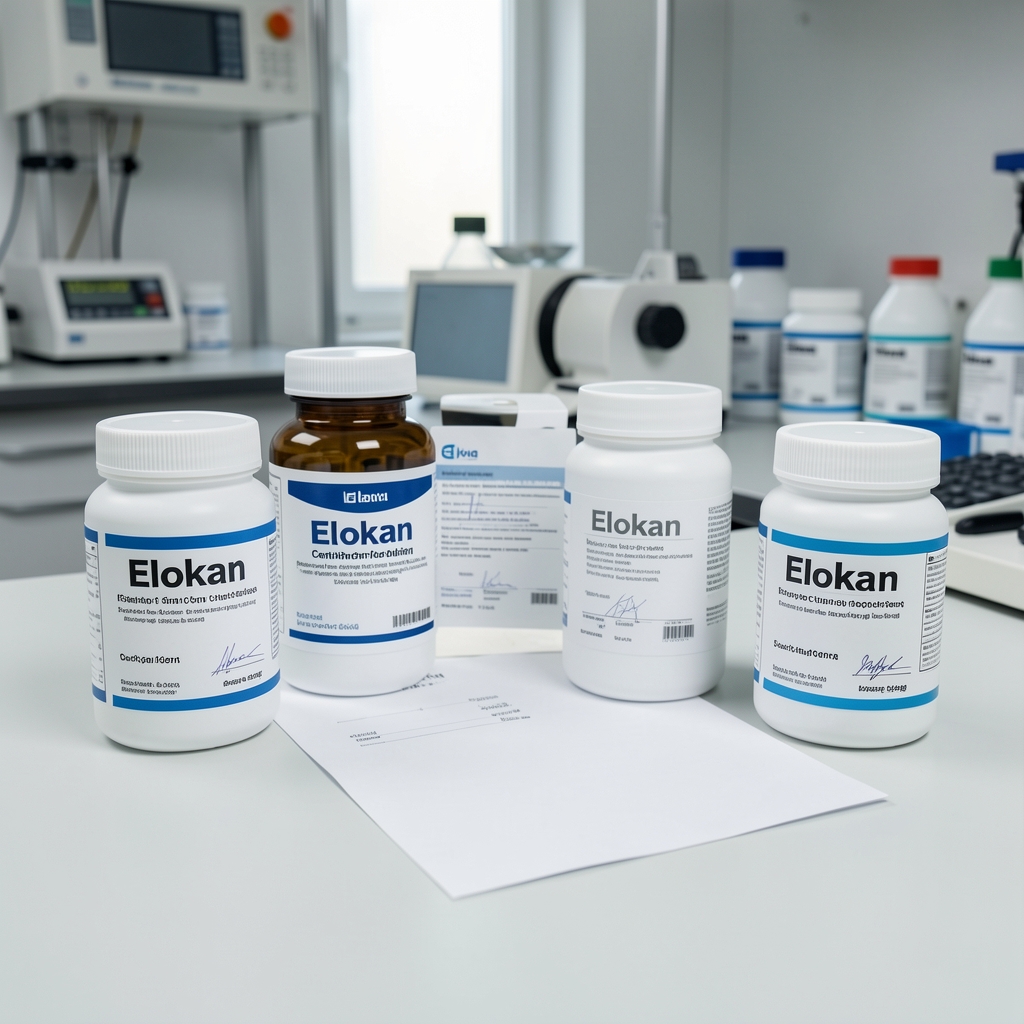
Before any Elokan batch is released for distribution, a sample is sent to an independent third-party laboratory for composition analysis. The laboratory analyses the sample for the presence and quantity of each declared active ingredient, checks for the absence of specified contaminants, and issues a certificate of composition referenced to the batch code.
Ingredient profiles in Elokan supplements are selected based on published nutritional research and undergo independent batch verification for quality and labelling accuracy. The certificate confirms that the label quantity of each ingredient is present within acceptable variance limits.
Batches that fail to meet the specification are not released. The failure is recorded, the root cause is investigated with the relevant supplier, and the corrective action is documented. No substitute batch is released until it has passed its own independent verification cycle. The full archive of batch certificates is maintained internally and is available for review on written request.
Retained supplier overview
Indonesian botanical and mineral processing facility. Supplies bisglycinate-chelated mineral forms with per-delivery certificate of analysis. Chain-of-custody documentation reviewed and approved in Q1 2023.
Malaysian vitamin manufacturing facility supplying microencapsulated vitamin D3 (lichen-derived) and methylcobalamin B12. All vitamins supplied with stability data and per-batch concentration certificates.
Dual-source botanical supplier with primary activities in India (ashwagandha root) and secondary sourcing from European processors (rhodiola rosea, tart cherry). All extracts are standardised-grade with active constituent percentages declared per batch.
Singapore-based distributor of specialty nutritional compounds. Supplies Kaneka Ubiquinol (CoQ10) and licensed Magtein magnesium threonate. All specialty compounds supplied with manufacturer certificates of analysis and originator traceability documents.
What the independent verification covers
Declared ingredient presence
Each active ingredient listed on the label is confirmed to be present at the stated quantity, within a ±10% variance allowance consistent with food supplement industry norms.
Contaminant screening
Batches are screened for the absence of specified heavy metal contaminants (lead, mercury, arsenic, cadmium) and microbial load, against food-grade acceptance limits.
Label accuracy confirmation
The certificate of composition confirms that the product label accurately represents the batch contents. Any discrepancy between label and analysis result triggers a hold-and-review process before distribution.
Elokan is an independent wellness resource focused on everyday nutrition and active lifestyle practices for men. The content is not affiliated with any governmental or institutional body. We recommend speaking with a qualified wellness or nutrition professional before introducing any supplement to your daily routine, particularly if you have specific dietary requirements.
Methodology — frequently asked
Each formula specification is reviewed on an annual cycle, typically in the first quarter. The review assesses whether new nutritional research warrants a change to ingredient inclusion or quantity. If a change is made, the updated formula is handled as a new batch series and undergoes the full four-stage process including independent verification before distribution.
Yes. Batch certificates are retained internally and can be provided on written request. Email [email protected] with the batch code printed on your unit. The certificate will be sent in PDF format within five working days.
Yes. Soft-Gel shells are HPMC (hydroxypropyl methylcellulose) — plant-derived, no gelatin. Excipients are limited to rice flour and plant-derived magnesium stearate. Both are declared on the product label. No artificial colourants, flavours, or preservatives are used.
A failed batch is not released. The root cause is identified — typically tracing back to a specific ingredient delivery — and the relevant supplier is notified. A corrective action is agreed, documented, and implemented before the next production run. The failed batch record is retained alongside the investigation notes and corrective action outcome.
HPMC soft-gel shells are sourced from a dedicated soft-gel manufacturer in Malaysia with documented food-grade facility standards. The soft-gel supplier undergoes the same qualification assessment as ingredient suppliers, including a review of chain-of-custody documentation and per-delivery certificates of specification compliance.
The formula review cycle — how it works
Each January, the Elokan formula specifications enter a structured review period. The review assesses three inputs: any significant new publications in the nutritional literature relevant to the active-men population, the outcome records from the past twelve months of independent batch verifications, and any documented feedback from the user base received via the contact channel.
Where the literature review identifies a shift in consensus on ingredient quantity or a newly documented compound with strong evidence for inclusion, the formula specification is revised accordingly. Revisions are handled as a new formula version, documented in the internal changelog, and the updated formulation undergoes the full four-stage process before release.
Where the verification record shows a pattern of variance in a particular ingredient (for example, consistently coming in at the low end of the ±10% tolerance), the quantity specification is adjusted upward to ensure that the released product is consistently within the declared range. This adjustment is documented and the relevant supplier is informed.
Published nutritional research reviewed. Current formula specifications assessed against updated literature. Revisions documented if required.
All four retained suppliers reassessed against the qualification checklist. Chain-of-custody documentation updated. Any supplier changes documented and qualification completed before the next production cycle.
Batch verification results from the first half of the year reviewed for patterns. Any recurring variance issues addressed with the relevant supplier. Corrective actions logged.
All batch certificates, supplier records, and formula review documents archived for the year. Annual summary report compiled. Inputs gathered for the following Q1 literature review.